
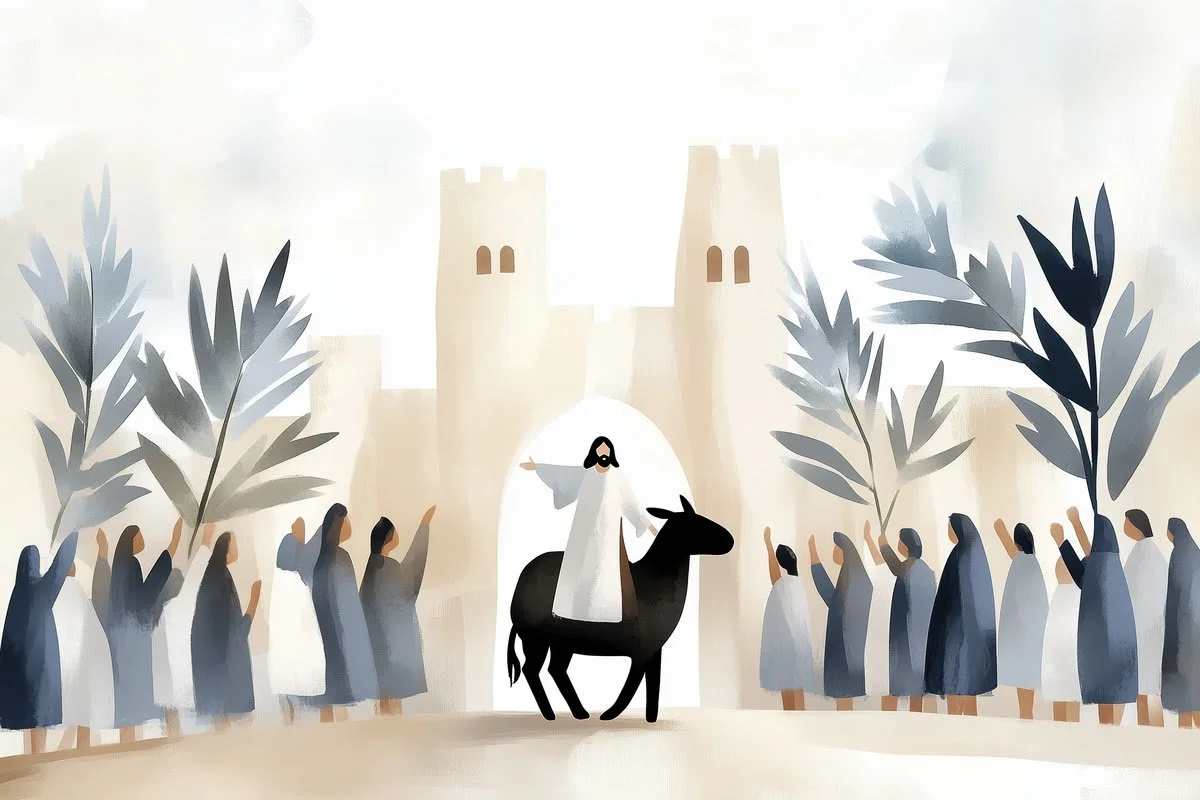
Jesus’ entry into Jerusalem was the fulfillment of a very specific prophecy in the Book of Zechariah regarding the coming King of Israel:
“Rejoice greatly, O daughter of Zion! Shout, O daughter of Jerusalem! Behold, your King is coming to you; He is just and having salvation, Lowly and riding on a donkey, A colt, the foal of a donkey,” Zechariah 9:9.
This prophecy was fulfilled to the letter in Matthew 21. Jesus even instructed two of His disciples to go to an adjoining village to find a donkey and its colt. The owners of the animals voice no objection when the disciples took them, after having stated their Master’s need of them.
Interestingly, only animals who had never been used as beasts of burden could be used for sacred rituals. In the Mosaic Law, for example, the red heifer used for sacrifice must be one “on which a yoke has never come” (Numbers 19:2). When the Philistines sent the Ark of the Covenant back to Israel, they built a new cart drawn by two milk cows “which have never been yoked” (1 Samuel 6:7). Jesus’ entry into Jerusalem was a religious as well as a political occasion. He was coming as their Savior as well as their King. Thus, the donkey on which He rode was one who had previously borne no burdens.
As Jesus entered Jerusalem, people laid palm branches in His path. In the ancient Middle East, it was customary for people to scatter plants and sometimes their garments in the streets when a person of honor was entering the city. The palm branch in particular was selected because it was a symbol of triumph and victory. These branches were used in celebration of the Feast of Tabernacles in the Old Testament (Leviticus 23:40). John also saw the Tribulation saints rejoicing in Heaven, holding palm branches (Revelation 7:9).
When Jesus entered the city, the people cried, “Hosanna,” a Hebrew term meaning “Please save,” and “Blessed is the King who comes in the name of the Lord!” (Luke 19:38). These salutations are quotes from Psalm 118:25-26, a Messianic Psalm. When the Pharisees asked Jesus to rebuke His disciples for what they believed was this unwarranted praise, our Lord replied:
“... I tell you that if these should keep silent, the stones would immediately cry out,” Luke 19:40.
The first 69 weeks of years of the prophecy of Daniel 9:24-27 had been completed. Four hundred and eighty-three years had passed since the Persian Empire had given permission for the Jews to return from Babylonian Captivity to Jerusalem, there to reconstruct the city and the Temple. It was time for Jesus’ triumphal entry, right down to the very day.
Palm Sunday is truly a beautiful illustration of Old Testament prophecy’s fulfillment in the Earthly ministry of Jesus Christ.