
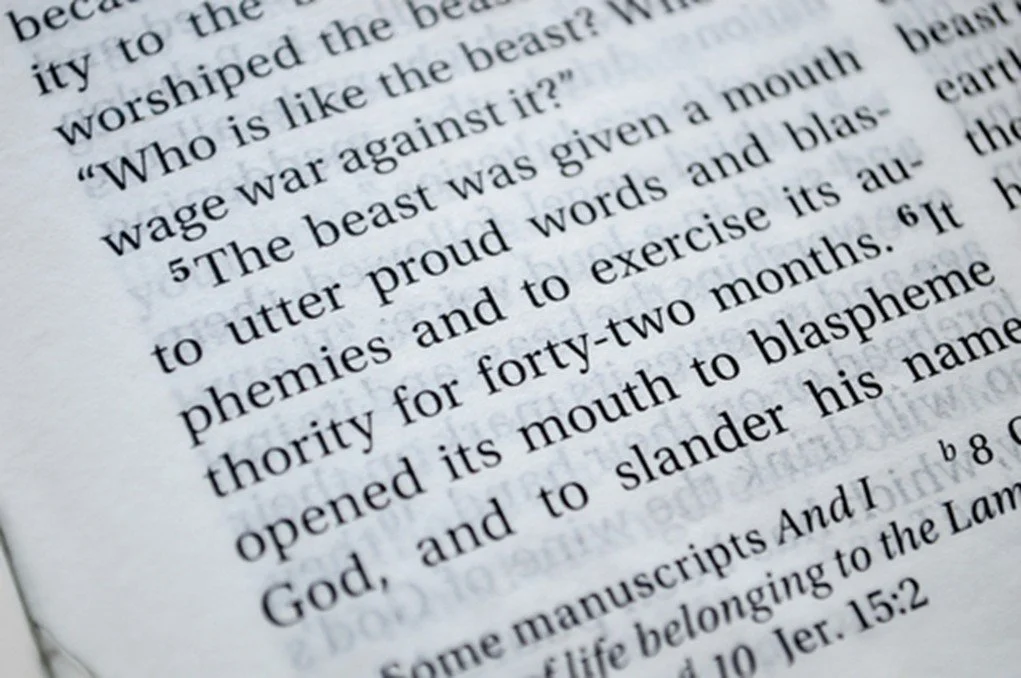
The advocates of a mid-Tribulation position remind us that it is at that point of the Tribulation — 3-1/2 years into the seven-year-period — when things go from “bad to worse,” so to speak. Until that time, the Antichrist will be consolidating his power on a massive scale while world events grow serious enough to demand his assumption of global leadership. Thus, according to this view, for the first half of the Tribulation, believers will not be forced into choosing either following the Antichrist or an almost certain death.
At the midpoint of the Tribulation, the Antichrist will break his covenant with Israel (Daniel 9:26-27). It is then that he will go into the newly rebuilt Temple in Jerusalem, proclaim himself God, and demand worship as such (2 Thessalonians 2:3-4). He will, in conjunction with his assistant, the False Prophet, also implement the Mark of the Beast at that time, without which no one can buy or sell (Revelation 13:16-18). Those who choose to reject the Antichrist’s mark will be pursued and martyred by his forces, as this mark is in essence a symbol of loyalty to him and his Satanic system.
Mid-Tribulation Rapture advocates believe, as we do, that God has not appointed us to wrath:
“For God has not appointed us to wrath, but to obtain salvation by our Lord Jesus Christ,” 1 Thessalonians 5:9.
But those of the mid-Tribulation position believe this wrath only begins at the midpoint of the Tribulation, rather than at its beginning, for the reasons we have indicated. However, they neglect to take into account that all of the seal, trumpet, and bowl judgments of the Book of Revelation also comprise the wrath of God. See, for example, Revelation 6:16-17. As these judgments are unleashed beginning at the onset of the Tribulation, they also fall under the heading of the “wrath” from which we are protected according the 1 Thessalonians 5:9. So, since the entire Tribulation is a time of the wrath of God, the pre-Tribulation position still has the most merit.
Those of a post-Tribulation position point out that at no time in Church history has God spared His people from persecution. Jesus Himself promised us, “In the world ye shall have tribulation” (John 16:33). Throughout the Church Age, this has certainly been the case. In fact, Christians today are being persecuted throughout the world. But they are experiencing the wrath of Satan or the wrath of man — not the wrath of God. The Bride of Christ is the object of His love, not of His wrath.
The Tribulation is a time of trouble that Jesus said would be unprecedented:
“For then shall be great tribulation, such as was not since the beginning of the world to this time, no, nor ever shall be. And except those days should be shortened, there should no flesh be saved: but for the elect’s sake those days shall be shortened,” Matthew 24:21-22.
The Tribulation is the judgment of God upon an unbelieving world. It is specifically directed to Israel, to compel them to turn to Jesus Christ as their Messiah. Thus, the Prophet Jeremiah called it “the time of Jacob’s trouble” (Jeremiah 30:7).
Jesus assured us He will come again and receive us to Himself and take us to Heaven (John 14:1-3). He cannot do that at the Second Advent, because He is coming here to Earth to implement His Millennial Reign (Revelation 20). So He must do so before that time.
Also, a post-Tribulation position presents Christians making a “U-turn” in the air, going up to meet Christ and then returning with Him to fight the Battle of Armageddon (Revelation 19:11-21). This does not provide time for Christians to go through either the Judgment of the Believer’s Works (2 Corinthians 5:10) or the Marriage of the Lamb (Revelation 19:7-9).
Although the advocates of these other positions do have arguments that may on the surface appear persuasive, it is clear that the pre-Tribulation position makes the most sense in light of all prophetic Scripture. Therefore, it is the one we advocate.